The Luxorium
2027 Solar Eclipse in Egypt: Complete Guide
On 2 August 2027, a total solar eclipse will cross southern Egypt. If you are inside the path of totality, the Moon will completely cover the Sun for a few minutes.
Totality (the Moon fully covering the Sun) happens only inside the path of totality.
Daylight will fall dramatically, the Sun's corona will become visible around the dark Moon, and the experience will be fundamentally different from a partial eclipse, even when most of the Sun is covered.[1]
For most travellers, one of the most important factors is whether the place they plan to watch from is inside the path of totality. That single fact changes what they will actually experience. This guide explains what totality is, where it crosses Egypt, why Egypt is attracting so much attention, and which destinations are worth looking at more closely.
Solar-viewing safety
Outside totality, proper solar-viewing protection is required whenever you look directly at the Sun. Only during totality — and only inside the path of totality — can the fully covered Sun be viewed without eclipse glasses.
What happens in Egypt on 2 August 2027?
A total solar eclipse happens when the Moon passes directly between the Sun and Earth and completely covers the Sun for observers within a narrow band called the path of totality. Outside that band, the eclipse remains partial: the Sun may be almost completely covered, but there is no total phase.[1]
What's the difference between a total and partial eclipse?
Partial eclipse
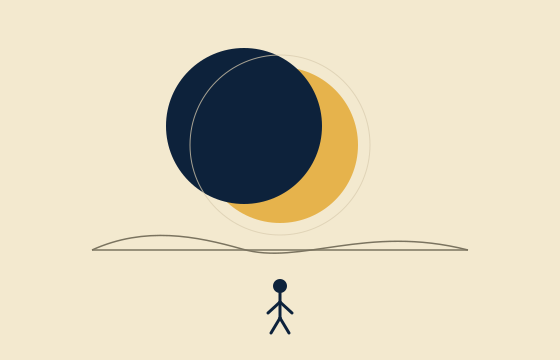
Part of the Sun remains visible
You are outside the path of totality.
Total eclipse
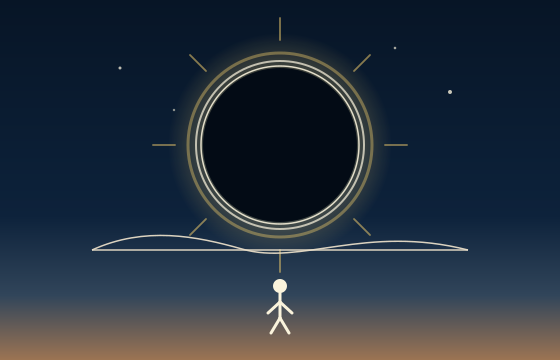
The Sun is fully covered
Daylight falls dramatically — it can feel like night.
You are inside the path of totality.
Solar viewing glasses are required during every partial phase. Only during totality can the Sun be viewed without them.
| Total eclipse | Partial eclipse |
|---|---|
| Total eclipseYou are inside the path of totality. | Partial eclipseYou are outside the path of totality. |
| Total eclipseThe Moon completely covers the Sun for a short period. | Partial eclipseSome of the Sun remains visible throughout. |
| Total eclipseDuring totality — and only during totality — the fully covered Sun can be viewed without eclipse glasses. | Partial eclipseProper solar viewing protection is required whenever you look directly at the Sun. |
| Total eclipseThe corona becomes visible and daylight changes dramatically. | Partial eclipseThe experience can still be striking, but it is not totality. |
NASA's eclipse-viewing guidance explains the eye-safety distinction in more detail.[1]
Coordinate-qualified
At the point of greatest duration in southern Egypt, totality lasts about 6 minutes 23.2 seconds.[2] Exact duration varies by precise coordinates, so city-level figures are best treated as approximate unless they are tied to a specific viewing location.
Where does the path of totality cross Egypt?
Totality crosses a broad band of southern and southwestern Egypt. The NASA/GSFC interactive eclipse map is the best starting point for checking whether an exact location is inside the path.[2]
Where totality crosses Egypt
2 August 2027
- Path of totality
- Centreline
- Luxor
- NASA greatest-duration point — longest totality ≈ 6m23s
Outside the shaded corridor, the eclipse is partial.
The path of totality crosses Egypt from the Western Desert through the Nile Valley and Eastern Desert before reaching the Red Sea. Luxor lies well within the path, close to the centreline.
NASA notes that lunar-limb topography may shift the calculated path limits by approximately 1–3 km. This map shows eclipse geometry, not viewing access or site suitability.
Luxorium visualisation based on NASA GSFC WGS 84 eclipse-path data. Eclipse Predictions by Fred Espenak, NASA's GSFC. Geographic base: Natural Earth.
For travellers, the main places and areas currently worth understanding are:
- Luxor and the Nile Valley. Luxor is inside the path and close to its centre. Some other Nile Valley towns, including Sohag, Asyut and Qena, are also inside the path. The eclipse path is well established, while tourism infrastructure and eclipse-specific visitor information vary considerably between locations.[6]
- The Southern Red Sea coast. Parts of the coast from around Quseir south through Marsa Alam and toward Berenice are inside the path. Exact duration changes meaningfully by town and viewing location, so the name of the broader destination is not enough — check the precise coordinates.[6]
- Siwa and Bahariya oases. Both are inside the path, and historical weather data suggests very low August cloud cover in both areas. The eclipse path and historical weather patterns are reasonably well documented; as of 19 August 2026, less eclipse-specific visitor information is publicly available than for Luxor or the main resort areas.[3][6]
Some popular Egyptian destinations are outside totality. Cairo/Giza and Aswan receive partial eclipses, not totality. Hurghada city is also outside the path of totality, even though parts of the Red Sea coast farther south are inside it.[6]
Solar-viewing safety
A location outside the path can still experience a partial eclipse in which most of the Sun is covered. The practical difference is that the Sun is never completely covered there, so proper eye protection remains necessary whenever you look directly at it.[1]
If experiencing totality matters to you, the hotel, tour or viewing package you choose can matter because the destination name alone may not tell you where you will actually watch the eclipse. Ask for the exact viewing location, then check those coordinates against the NASA/GSFC eclipse map rather than relying only on a city name or marketing description.
Why is Egypt attracting so much attention for the eclipse?
Three things make Egypt especially significant for the 2027 eclipse.
- Exceptionally long totality. NASA's eclipse catalog shows that the 2009 total eclipse lasted longer at its maximum, but the next total eclipse with a longer maximum duration than 2027's does not occur until 2114.[2] The useful traveller takeaway is simpler: parts of southern Egypt will experience more than six minutes of totality.
- Historically clear August skies. Historical weather data shows very low August cloud frequency across much of the eclipse path in Egypt. Around Luxor, the source dataset gives an August cloud frequency of about 0.7%. That is a historical pattern, not a forecast for 2 August 2027.[3]
- Established places to travel to. The path includes recognised travel destinations such as Luxor, Marsa Alam, Siwa and Bahariya, as well as resort areas farther south on the Red Sea coast.[6] That gives travellers several realistic bases to consider rather than only remote points on an eclipse map.
Much of Upper Egypt (the name used for southern Egypt because it lies upstream on the Nile) sits within the most important part of the Egyptian eclipse path.
Why does Luxor get so much attention for the August 2027 Solar Eclipse?
Luxor sits close to the centre of the path of totality and has an established tourism base, alongside one of Egypt's best-known concentrations of ancient sites. That makes it an obvious focus for international eclipse travel. It also means heat, crowding, transport and eclipse-day operations matter when deciding whether Luxor is the right fit for you.
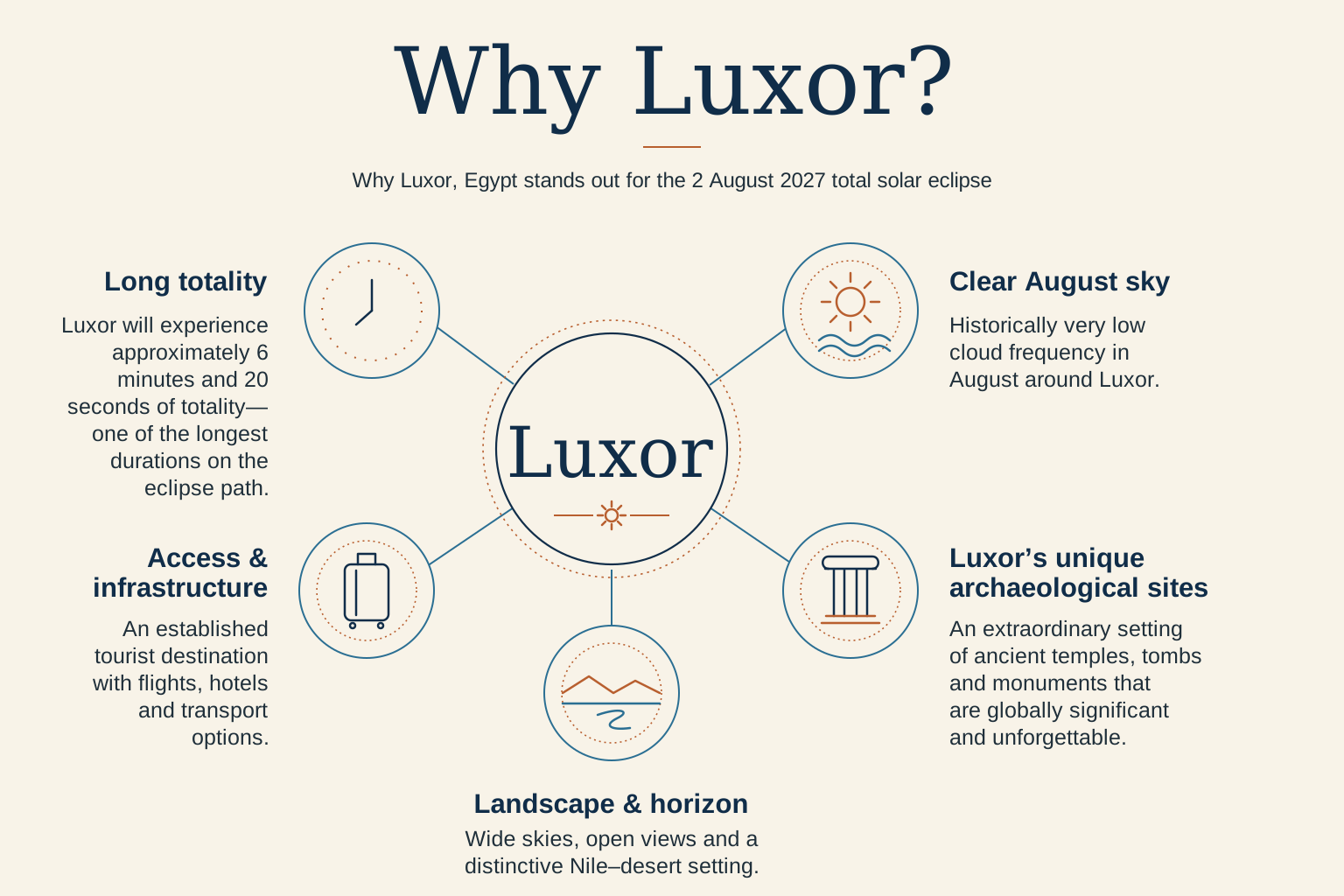
Why Luxor, Egypt stands out for the 2 August 2027 total solar eclipse
- Long totality
- Luxor will experience approximately 6 minutes and 20 seconds of totality — one of the longest durations on the eclipse path.
- Clear August sky
- Historically very low cloud frequency in August around Luxor.
- Access and infrastructure
- An established tourist destination with flights, hotels and transport options.
- Luxor's unique archaeological sites
- An extraordinary setting of ancient temples, tombs and monuments that are globally significant and unforgettable.
- Landscape and horizon
- Wide skies, open views and a distinctive Nile–desert setting.
This guide does not compare Luxor against the alternative viewing locations in Egypt. If you are still deciding where to go, compare the main Egyptian eclipse destinations. If Luxor is already your likely choice, plan your Luxor eclipse trip.
Has Egypt hosted a major eclipse gathering before?
Yes. On 29 March 2006, a total solar eclipse crossed Al Salloum near Egypt's border with Libya. It was a very different setting from Luxor, but it provides a useful real-world precedent. One contemporaneous report estimated roughly 70,000 tourists and about 500 scientists, with the Egyptian president also attending.[4] These are useful scale indicators rather than a precise attendance count.
The 2027 eclipse will not necessarily work the same way. But one of the most useful lessons is that official access, traffic and security arrangements can materially shape an eclipse day. In 2006, visitors were directed into government-designated viewing areas and movement was tightly controlled while the president was present.[4] For 2027, Egypt has already begun formal planning, but many operational details are still developing.[5]
What is still unknown or changing?
Some of the astronomy is fixed. Many of the practical arrangements are not.
What we're watching
-
Coordinate-dependent
Exact local duration depends on exact coordinates. Broad city-level figures are useful for orientation, but precise duration varies by location.[2]
-
Confirmed — detail not yet published
Formal government planning is confirmed. Egypt's Ministry of Tourism and Antiquities has established a committee to prepare for the Luxor eclipse and coordinate with tourism businesses and other authorities. As of 19 August 2026, we have not found published operational detail covering matters such as final site capacities, traffic routing or designated viewing arrangements.[5]
-
Changing
Accommodation and transport conditions are changing. As of 18 August 2026, publicly advertised eclipse-week offers already show substantial differences in price and availability. We will share the best verified information we have available in the destination comparison and Luxor planning guidance rather than presenting broad claims that "everything is sold out".[7]
Last checked: 19 August 2026
Know more about this? If you have official guidance, confirmed operator information or first-hand local information that could improve the current picture, use Ask or Correct to send it to us. We review contributions before relying on them.
Planning your eclipse trip
If you only needed to understand the event, the key point is enough: southern Egypt offers exceptionally long totality and historically very clear August skies, but experiencing totality still depends on choosing an exact location inside the path.
If you are planning a trip, compare the main locations based on whether they are inside totality, historical weather, travel logistics and the kind of experience you want.
-
Where to watch
Still choosing a destination?
-
Planning Luxor
Already leaning toward Luxor?
Sources
-
NASA
Solar Eclipse Safety
science.nasa.gov/eclipses/safety
NASA confirms that eye protection is required during partial phases and may be removed only during the brief total phase when the Sun's bright face is completely covered.
-
NASA / GSFC
Path of Total Solar Eclipse of 2027 Aug 02
eclipse.gsfc.nasa.gov/SEpath/SEpath2001/SE2027Aug02Tpath.html
2027 interactive eclipse map
eclipse.gsfc.nasa.gov/SEgoogle/SEgoogle2001/SE2027Aug02Tgoogle.html
Catalog of Long Total Solar Eclipses: 2001–3000, and 2114 eclipse data
Greatest Duration for 2027 is 06m23.2s near 26°49′N, 31°08′E.
-
Jay Anderson
Eclipsophile — Total Solar Eclipse 2027 August 2
Historical satellite weather data is used as a long-run viewing-condition indicator, not as a forecast.
-
2006 Al Salloum precedent
Kuwait News Agency, 29 March 2006
Reporting an estimated 70,000 tourists and around 500 scientists, with President Hosni Mubarak expected to attend.
Barbara and Phil Seeger, March 29, 2006 Eclipse — Sallum, Egypt
Describes the official eclipse camp and tight movement/security controls during the president's presence.
Attendance figures should be treated as contemporary estimates, not a precise count.
-
Egypt Ministry of Tourism and Antiquities
2026 announcement establishing a ministerial committee to prepare for the 2 August 2027 Luxor eclipse, coordinate with tourism businesses and relevant authorities, manage visitor flows and reduce congestion at main viewing areas
As of 19 August 2026, the announcement does not provide final site capacities, traffic routes or designated viewing arrangements.
-
NASA / GSFC and Experience Egypt
NASA/GSFC, 2027 interactive eclipse map
For whether named locations fall inside or outside the path of totality.
Egypt's official Experience Egypt destination information
LuxorMarsa AlamSiwaAl-Bahariyya
Confirms Luxor, Marsa Alam, Siwa and Al-Bahariyya as established travel destinations.
The comparison of eclipse-specific visitor information is a dated assessment of what is publicly available as of 19 August 2026, not a judgement about local capability.
-
Public eclipse-week accommodation examples
Checked through 18 August 2026, these show different price and availability states rather than one uniform market condition.
Egypt Discovery
Advertised a four-day Luxor hotel stay from £2,360 per person with availability to check.
Habu Hotel
Listed several room categories as sold out while four pool-view suites remained available at USD 10,000 total.
These are examples, not a complete inventory of Luxor accommodation.